CENTCOM deploys Saronic Corsair USV against Iranian submarine at Bandar Abbas
Naval News · 13 juillet 2026 · Anglais · collecté le 3 septembre 2026
Article original ↗ Archive PDF ⬇
Trois Corsair frappent un sous-marin de poche de classe Ghadir à quai sur la base navale de Bandar Abbas. Premier emploi au combat de drones de surface par les forces américaines, en mode one-way attack. CENTCOM justifie l'opération par la dégradation de la capacité iranienne à frapper le trafic commercial.


- News
- Event News
- CNE 2026
- Sea Air Space 2026
- DIMDEX 2026
- Indo Pacific 2025
- DSEI UK 2025
- IDEF 2025
- MADEX 2025
- Interviews
- Features
- Videos
- Advertising
- Event News
- CNE 2026
- Sea Air Space 2026
- DIMDEX 2026
- Indo Pacific 2025
- DSEI UK 2025
- IDEF 2025
- MADEX 2025
- Interviews
- Features
- Videos
- Advertising
- About Us
Search
Search
Home » CENTCOM Deploys Saronic Corsair USV Against Iranian Submarine At Bandar Abbas

CENTCOM Deploys Saronic Corsair USV Against Iranian Submarine At Bandar Abbas
- Published on 13/07/2026
- By Aaron-Matthew Lariosa
- In
News
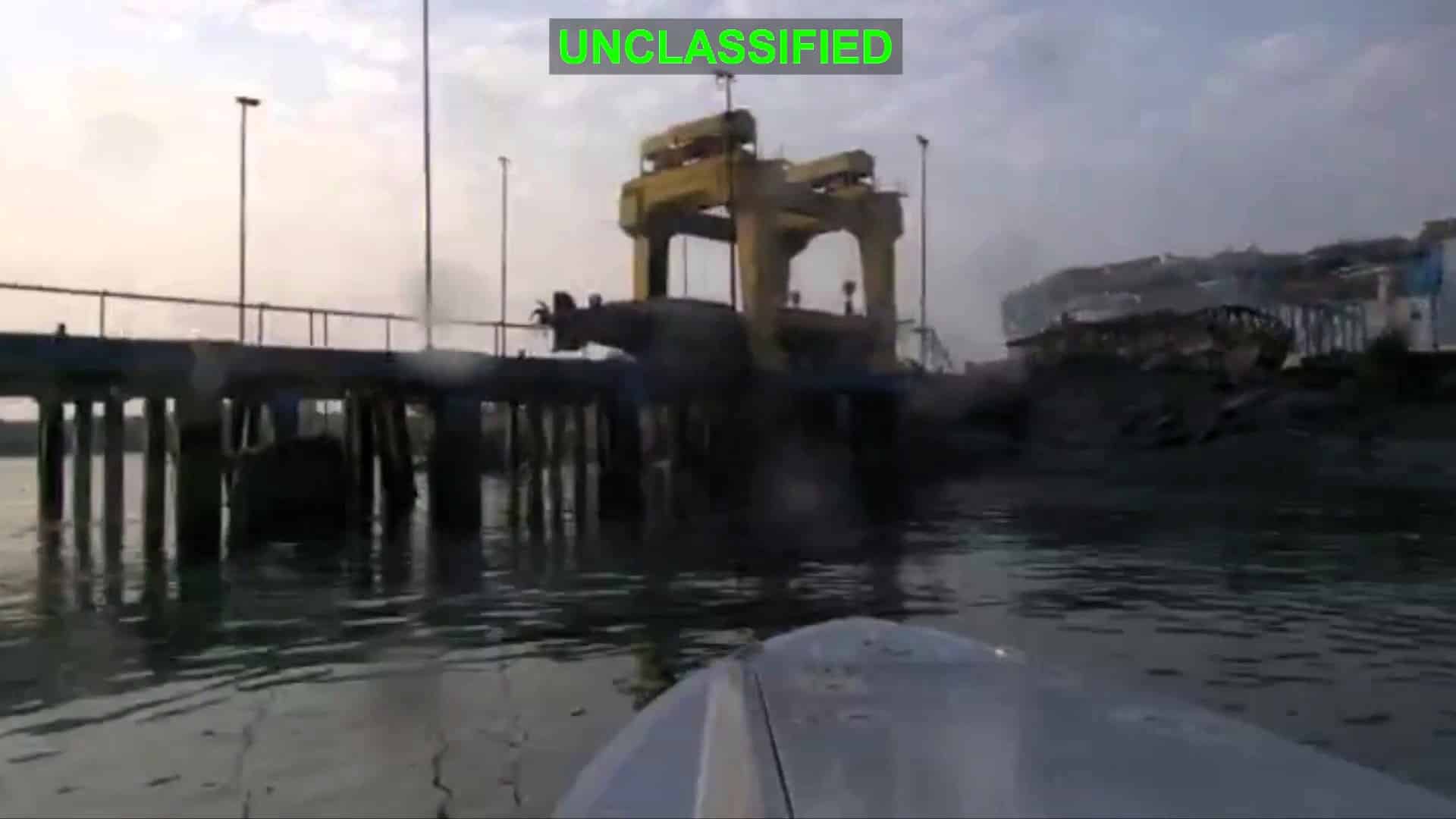
Screen capture from CENTCOM video showing the Saronic kamikaze USV moments before impact.
In a first-of-its-kind operation, U.S. Central Command (CENTCOM) utilized three Saronic Corsair unmanned surface vessels to strike a docked Ghadir-class midget submarine at Iran's Bandar Abbas Naval Base.
Share
Three Saronic Corsair unmanned surface vessels (USV) attacked a laid up Iranian midget submarine in a first of its kind operation by American forces using maritime one-way attack drones.
According to U.S. Central Command (CENTCOM), the trio of USVs attacked the Bandar Abbas Naval Base over the weekend.
Three Corsair unmanned surface vessels hit the port at Bandar Abbas Naval Base, marking the first time American forces have employed sea drones in combat operations. Last night’s strikes degraded Iran’s ability to continue attacking commercial shipping,” reads a CENTCOM release on the operation.
A release from the command revealed the debut of the maritime strike attack drones on Sunday, but footage was withheld until a social media post from CENTCOM today. The compilation of the attack shows the drones approaching a docked Ghadir-class midget submarine within the naval installation. Footage from an overhead aerial intelligence platform depict the Corsair USVs approaching the dock at different angles prior to detonating their explosive payloads.
For Saronic, an American drone firm specializing in USVs, the conflict garnered significant publicity for the company after a Corsair USV rescued two Apache attack helicopter pilots last month. The Corsair can operate out to 1,000 nautical miles and carry payloads of 1,000-pounds. A social media post from Saronic revealed that the firm has produced at least 300 Corsair USVs as of May 2026. The company won in December 2025 a Corsair production contract for the US Navy.
Saronic issue the following statemen about the recent strike: “We are proud that our technology supported this mission and helped to keep the brave men and women of the U.S. armed forces safe. Saronic remains committed to delivering autonomous maritime systems that strengthen the security of America and its allies.”
Yesterday, using multiple one-way attack surface drones, CENTCOM forces successfully struck a submarine and ship maintenance facility in Iran. Three Corsair unmanned surface vessels hit the port at Bandar Abbas Naval Base, marking the first time American forces have employed sea… pic.twitter.com/bOM2kmgRxz
— U.S. Central Command (@CENTCOM) July 13, 2026
The drone start-up formed following the asymmetric effects of unmanned maritime deployments in the Russian-Ukrainian War. Ukraine has torn apart Russia’s larger and more capable fleet with USVs sneaking into Black Sea naval bases in strikes akin to Sunday’s Bandar Abbas attack.
The first-ever use of American one-way attack drones occurred during a wave of offensive strikes following renewed tensions between Iran and the U.S. over the status of commercial shipping transiting Strait of Hormuz. CENTCOM claims that Sunday’s strikes, which saw dozens of attacks against Tehran’s air defense and coastal defense systems, aimed to degrade Iran’s capability to attack international shipping.
Since the outbreak of the U.S.-Iran War, Washington has deployed several new long-range strike systems in its efforts against Iranian forces. These include the Precision Strike Missile, a new munition capable of striking targets 500 kilometers away, and Low-Cost Uncrewed Combat Attack System aerial attack drones. Early on in the war, U.S. forces focused their strikes against Iran’s warships, drones, missile launchers and minelaying forces poised against the Strait of Hormuz.
Tags

Aaron-Matthew Lariosa
Aaron-Matthew is a freelance defense journalist covering the South China Sea, U.S. military efforts in the Indo-Pacific and Armed Forces of the Philippines modernization.
PrevArticle précédentUSMC Eyes General Atomics’ Bullseye Cruise Missile to Counter China
Advertisement
Advertisement

Advertisement

Read more
US Navy RFI Details Plans for Carrier-Based Collaborative Combat Aircraft (CCA)

Japan Plans to Adopt ASM-3ER Anti-Ship Missile for Air-to-Air Role
Do you like our content ?
Naval News brings you news coverage of the latest naval defense shows & events. We are also reporting on naval technology from all over the world.
Name
Subscribe now
Follow us
News
- All news
- Event news
- Interviews
- Videos
- Cavasships
Advertising
Lorem ipsum dolor sit amet, consectetur adipisicing elit.
Read more
Legal
- Privacy policy
- About Naval News
- Contact us
Follow us
Lorem ipsum dolor sit amet, consectetur adipisicing elit.
Facebook-f
Linkedin-in